- Understanding 100g: A Comprehensive Guide
- What is 100g?
- 100g in Common Foods
- Convert 100g to Other Units
- Importance of 100g in Cooking and Baking
- Nutritional Aspects of 100g
- 100g in Fitness and Health
- Common Mistakes in Measuring 100g
- 100g Related Products and Tools
- Conclusion: The Versatility of 100g
- Frequently Asked Questions (FAQ)
- How much is 100g in cups?
- Is 100g equivalent to 0.1kg?
- How many ounces are there in 100g?
- Can 100g be considered a serving size?
- Why do recipes use 100g instead of pounds?
Understanding 100g: A Comprehensive Guide
When it comes to measurements in cooking, fitness, or any field requiring precision, understanding the weight representation of 100 grams can be vital. Whether you’re converting recipes, planning meals, or calculating nutritional intake, knowing how 100 grams translates into everyday usages can make a significant difference.
What is 100g?
Grams are a unit of mass in the metric system, equivalent to one-thousandth of a kilogram. In practical terms, 100 grams (commonly represented as 100g) is a way to measure weight, widely used worldwide except in the United States where the imperial system is preferred. For instance, 100 grams of flour or sugar is commonly noted in recipes for its simplicity and precision.
100g in Common Foods
Understanding how much 100g represents in terms of common foods can be helpful, especially for cooking and nutritional tracking. Below is a list of typical foods and their approximate 100g conversions:
- 100g of flour: Almost 3/4 cup
- 100g of sugar: About 1/2 cup
- 100g of butter: Approximately 7 tablespoons
- 100g of cooked rice: Around 1/2 cup
- 100g of chicken breast: About 1/2 a breast
Convert 100g to Other Units
Conversions are often necessary as different countries and individuals use different systems. Here’s how 100g translates into other units:
| Unit | Equivalent of 100g |
|---|---|
| Kilograms (kg) | 0.1 kg |
| Pounds (lb) | 0.22 lb |
| Ounces (oz) | 3.53 oz |
| Milliliters (ml) for water | 100 ml |
Importance of 100g in Cooking and Baking
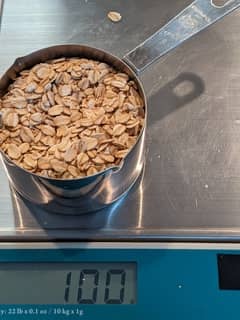
In culinary arts, precision is key. A discrepancy of even a few grams can alter the taste and texture of your dish. Professional chefs and bakers often rely on scales that measure in grams to ensure accuracy. For those working with recipes originating outside the US, understanding metric measurements like 100g ensures better results.
Nutritional Aspects of 100g
Many food labels list nutritional information per 100g, allowing consumers to understand energy content, macronutrient distribution, and nutrient density of the food they consume. For example, understanding that 100g of cooked quinoa contains approximately 120 calories and 4.1g of protein can help in dietary planning.
100g in Fitness and Health
When tracking dietary intake for fitness purposes, knowing how many grams are in a serving is essential. For instance, calculating protein intake often involves converting servings of food into grams. Practically, this means ensuring that 100g of protein, distributed throughout your day, matches your dietary goals.
Common Mistakes in Measuring 100g
Avoid the pitfalls that can arise when measuring 100g. A few common mistakes include not leveling off dry ingredients, using the wrong type of scale (digital vs. analog), and not considering the density of various foods which can mislead volume-based estimates.
100g Related Products and Tools
Here are tools that can help accurately measure 100g:
- Digital Kitchen Scales: Offer precision up to 1g for exact measurements.
- Measuring Cups with Metric Markings: Ensure correct volume conversions.
- Calibrated Scoops for Powdered Substances: Useful for protein powders and baking ingredients.
Conclusion: The Versatility of 100g
From cooking to nutrition and beyond, mastering the concept of 100 grams can deepen your culinary repertoire, improve dietary planning, and enhance the understanding of daily weights. It’s not just a number, but a critical mass that echoes across various applications, simplifying complex measurements.
Frequently Asked Questions (FAQ)
How much is 100g in cups?
100g of water is approximately equivalent to 0.42 cups.
Is 100g equivalent to 0.1kg?
Yes, 100g is precisely 0.1kg.
How many ounces are there in 100g?
There are 3.53 ounces in 100g.
Can 100g be considered a serving size?
A serving size varies by food, but 100g is a standard metric measurement used to compare nutritional values.
Why do recipes use 100g instead of pounds?
100g is used for precision and uniformity across recipes, making scaling and conversions easier compared to the imperial system.