- Understanding the Annual Salary: $23 Per Hour
- How Much Is $23 Per Hour Annually?
- What Factors Influence Annual Earnings?
- Comparing Hourly Wages Across Industries
- Is $23 Per Hour a Good Wage?
- Strategies to Maximize Your Income
- Common Mistakes to Avoid
- Alternatives and Comparisons: $23 Per Hour vs Monthly and Bi-weekly Salaries
- Concluding Thoughts
- FAQ
- What is $23 per hour on a yearly basis?
- How does $23 per hour fare in different industries?
- Can I live comfortably on $23 per hour?
- What steps can I take to increase my hourly wage?
- Why is understanding deductions important?
Understanding the Annual Salary: $23 Per Hour
Have you ever wondered how much $23 per hour translates to in annual earnings? Whether you’re evaluating a job offer or considering asking for a raise, understanding the annual salary equivalent of an hourly wage can be crucial. This comprehensive guide explores how $23 per hour translates to an annual salary, providing insights into related evaluations, comparisons, and financial tips.
How Much Is $23 Per Hour Annually?
To calculate an annual salary from an hourly wage, you’ll need to know the number of hours worked per week and the number of weeks worked per year. Typically, a full-time employee works 40 hours per week and 52 weeks per year.
- Hourly Rate: $23
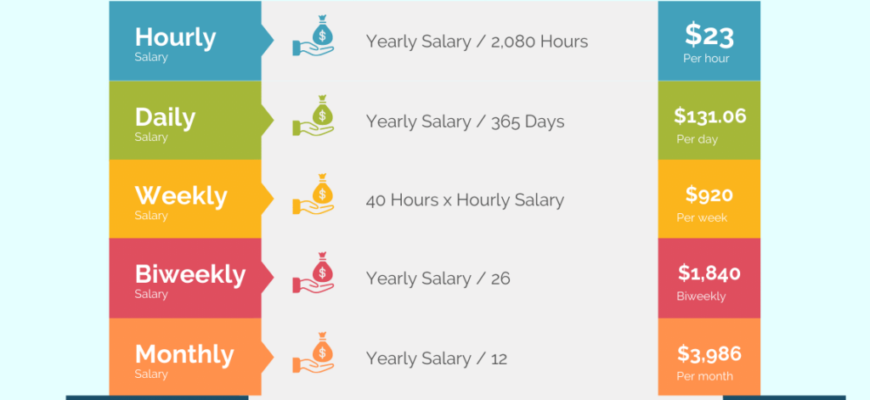
- Weekly Earnings: $23 x 40 hours = $920
- Annual Earnings: $920 x 52 weeks = $47,840
Therefore, at $23 per hour, you would earn approximately $47,840 annually before taxes.
What Factors Influence Annual Earnings?
While hourly wage is crucial, factors like overtime, taxes, and benefits can significantly impact annual earnings. Understanding these factors is essential for an accurate financial forecast.
- Overtime Pay: Working over 40 hours typically earns overtime pay.
- Tax Deductions: Federal and state taxes, along with Social Security, will reduce take-home pay.
- Benefits and Bonuses: Consider health insurance, retirement plans, and year-end bonuses.
Comparing Hourly Wages Across Industries
Different industries have varying standards for hourly wages. Let’s explore how $23 per hour compares:
| Industry | Average Hourly Rate |
|---|---|
| Retail | $15 – $20 |
| Healthcare | $25 – $40 |
| Information Technology | $30 – $60 |
This table illustrates how $23 per hour aligns with or differs from average hourly rates in various sectors.
Is $23 Per Hour a Good Wage?
The adequacy of $23 per hour depends on location, lifestyle, and individual financial goals. In some regions, $23 per hour may suffice for a comfortable lifestyle, while in others, it may fall short.
- Cost of Living: High-cost areas may require a higher wage for the same lifestyle.
- Personal Expenses: Consider housing, utilities, and groceries.
- Financial Goals: Savings, investments, and retirement should also be factored in.
Strategies to Maximize Your Income
If aiming to expand your earnings beyond $23 per hour, several strategies can be effective:
- Negotiation: Learn how to negotiate salary and benefits.
- Skill Development: Further education and skill upgrades can boost employability and earnings.
- Side Hustles: Part-time or freelance work can supplement income.
Common Mistakes to Avoid
Missteps in handling hourly wages can affect financial stability. Here are mistakes to avoid:
- Ignoring Taxes: Calculate after-tax income for realistic budgeting.
- Neglecting Benefits: Consider the full compensation package, not just wage.
- Overlooking Expenses: Account for all living expenses in financial planning.
Alternatives and Comparisons: $23 Per Hour vs Monthly and Bi-weekly Salaries
For a broader perspective, consider how $23 per hour stacks up against monthly and bi-weekly earnings:
- Monthly: $47,840 / 12 = $3,986.67
- Bi-weekly: $47,840 / 26 = $1,840
Concluding Thoughts
Understanding how $23 per hour translates into an annual salary involves more than basic math. By considering factors like location, lifestyle, and benefits, a comprehensive perspective on financial health is achieved. Applying strategies like negotiation and skill development can enhance potential earnings and improve life quality.
FAQ
What is $23 per hour on a yearly basis?
$23 per hour equates to an annual salary of approximately $47,840, assuming full-time work without overtime.
How does $23 per hour fare in different industries?
In industries like retail, $23 per hour is considered competitive, while in IT, it is on the lower end of the wage spectrum.
Can I live comfortably on $23 per hour?
Living comfortably on $23 per hour depends on various factors like your region’s cost of living and personal financial management.
What steps can I take to increase my hourly wage?
Consider negotiation, enhancing skills, further education, and exploring side hustles to boost earnings.
Why is understanding deductions important?
Deductions significantly impact your take-home pay, so awareness helps in accurate financial planning and budgeting.