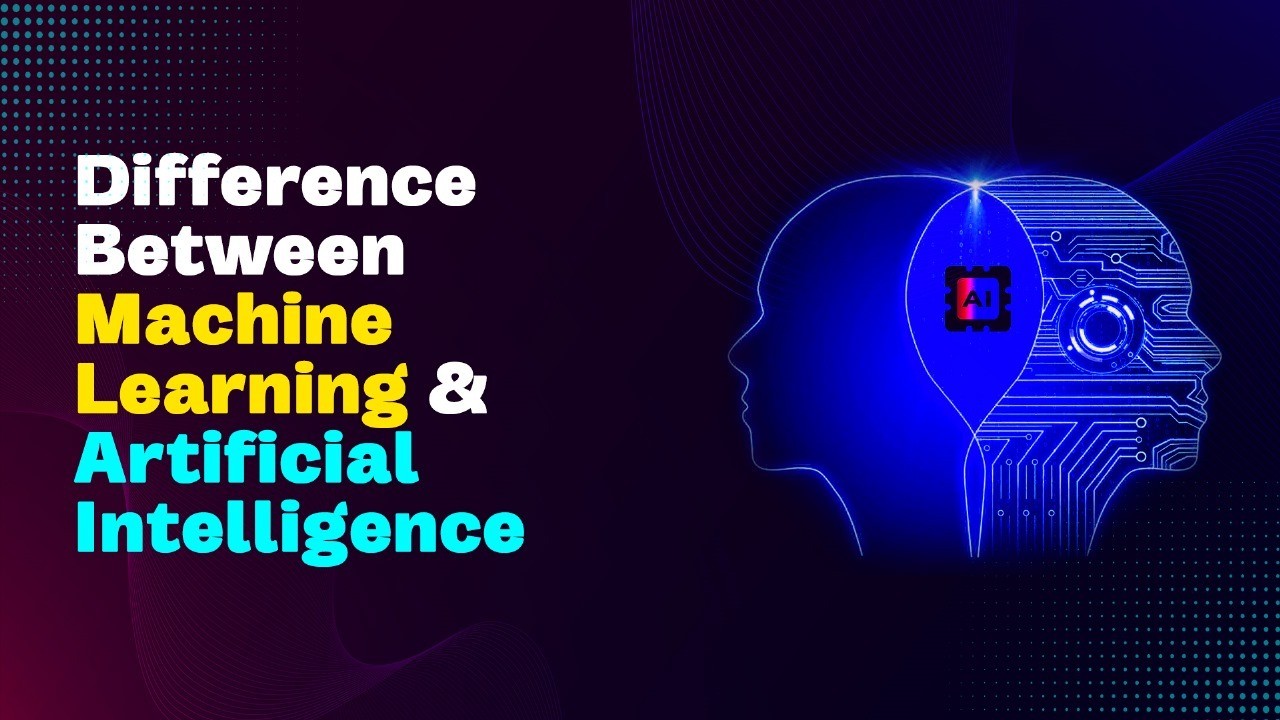
Artificial intelligence (AI) is the broad field of machines doing tasks that need human-like intelligence, and machine learning (ML) is a subset where systems learn from data.
AI
Artificial intelligence is the broad field of building machines that perform tasks that need human intelligence: reasoning, language, vision.
ML
Machine learning is a subset of AI. Systems learn patterns from data without being explicitly programmed.
Deep learning
A subset of ML using neural networks.
Relationship
AI includes ML. ML includes deep learning.
Examples
AI: chatbots, robots. ML: spam filters and recommendations.
Layers and examples
Artificial intelligence is the broad field of making machines perform tasks that need human-like intelligence. Machine learning is a subset where systems learn patterns from data rather than following explicit rules. Deep learning is a subset of ML that uses neural networks with many layers. Large language models like GPT are deep learning models trained on large text datasets.
- Classic ML algorithms include linear regression, decision trees, random forests and support vector machines.
- Supervised learning uses labeled data, unsupervised learning finds structure in unlabeled data and reinforcement learning learns from rewards.
- Not all AI is ML. Rule-based expert systems of the 1980s and chess engines such as Deep Blue (1997) used hand-coded rules and search.
Typical applications
Spam filters, recommendation systems, fraud detection and image recognition use ML. Self-driving systems combine ML perception with planning code. The term artificial intelligence was coined at the 1956 Dartmouth workshop, and machine learning was popularized by Arthur Samuel in 1959 through his checkers program. Model quality depends on data quality, evaluation and monitoring for bias.
Layers and examples
Artificial intelligence is the broad field of building systems that perform tasks associated with human intelligence. Machine learning is a subset where algorithms learn patterns from data rather than following explicit rules. Deep learning is a subset of machine learning using multilayer neural networks. Large language models, such as those behind chat assistants, are deep learning systems trained on large amounts of text.
Typical applications
Machine learning powers spam filters, recommendation systems, fraud detection and medical image analysis. AI also includes rule based expert systems, search algorithms and robotics planning that do not learn from data. Deep learning has enabled advances in speech recognition and image classification since the ImageNet results in 2012.
Concepts and techniques
Machine learning types are supervised (labeled data), unsupervised (finding structure) and reinforcement learning (rewards). Deep learning stacks many neural layers. AI also covers search, planning, logic and knowledge representation, often called classical or symbolic AI. Large language models like GPT and Claude are trained on trillions of tokens.

Milestones
1956 Dartmouth workshop coined artificial intelligence. IBM Deep Blue beat Garry Kasparov in 1997. AlexNet won ImageNet in 2012 using deep learning. AlphaGo beat Lee Sedol in 2016. Transformers were introduced in 2017.
Based on data from Stanford University’s AI Index and the Association for the Advancement of Artificial Intelligence