Percent difference equals the absolute difference of the two numbers divided by their average, times 100.
Formula
Percent difference = |a minus b| divided by ((a + b) / 2), times 100.
Example
For 50 and 70: difference 20, average 60, so 20 / 60 = 33.3%.
Percent change vs difference
Percent change uses the starting value as the base. Percent difference uses the average, for two values with no order.
Check

The result is the same in either direction.
Percent difference vs percent change, side by side
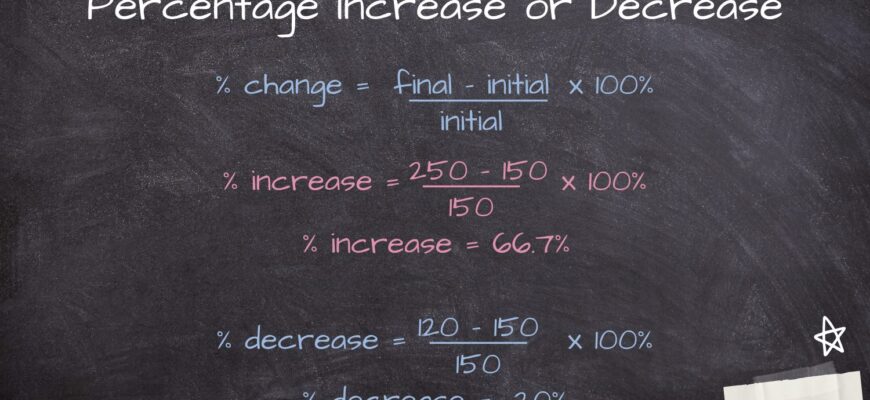
Percent difference treats the two numbers as equals and divides by their average: |a – b| / ((a + b) / 2) x 100. Percent change has a clear starting value: (new – old) / old x 100. Use percent difference when neither number is the reference, for example two lab measurements. Use percent change for before and after values such as prices.
- Example, percent difference between 40 and 60: 20 / 50 x 100 = 40 percent.
- Example, percent change from 40 to 60: 20 / 40 x 100 = 50 percent increase.
- Example, percent change from 60 to 40: 20 / 60 x 100 = 33.3 percent decrease.
Common mistakes

Percent points and percent are different. A rate that rises from 10 to 15 percent is a 5 percentage point increase and a 50 percent relative increase. A 50 percent drop followed by a 50 percent rise does not return to the start: 100 becomes 50, then 75. If the old value is zero, percent change is undefined. In spreadsheets, the formula =(B2-A2)/A2 formatted as a percentage gives percent change, and =ABS(A2-B2)/AVERAGE(A2,B2) gives percent difference.
Formulas side by side
Percent difference compares two values with no reference point: |A minus B| divided by the average of A and B, times 100. Percent change measures change from an original value: (new minus old) divided by old, times 100. Example: 50 versus 80 gives a percent difference of 30 divided by 65, which is 46.2 percent, but the percent change from 50 to 80 is 60 percent, and from 80 to 50 is minus 37.5 percent.
Frequent mistakes
Percent change is not symmetric: a 50 percent increase followed by a 50 percent decrease does not return to the start, since 100 becomes 150 and then 75. Percentage points differ from percent: a rise from 10 percent to 12 percent is 2 percentage points, or a 20 percent relative increase. Use percent difference when neither number is the baseline, and percent change when time or an original value matters.
Worked examples
Percent difference between 40 and 60: difference 20, average 50, so 20 divided by 50 is 40 percent. Percent change from 40 to 60: 20 divided by 40 is 50 percent. Percent change from 60 to 40: minus 20 divided by 60 is minus 33.3 percent. Percentage points are different: from 40 percent to 60 percent is 20 percentage points.

Where each is used
Percent difference compares two measurements of equal standing, such as two lab readings or the same item at two stores. Percent change is for before and after, such as prices, population, revenue or stock moves. Relative error compares a measurement with a true value: |measured minus true| divided by true. In spreadsheets, percent difference is ABS(A-B)/AVERAGE(A,B) and percent change is (B-A)/A.
Based on data from standard mathematics references and the National Institute of Standards and Technology