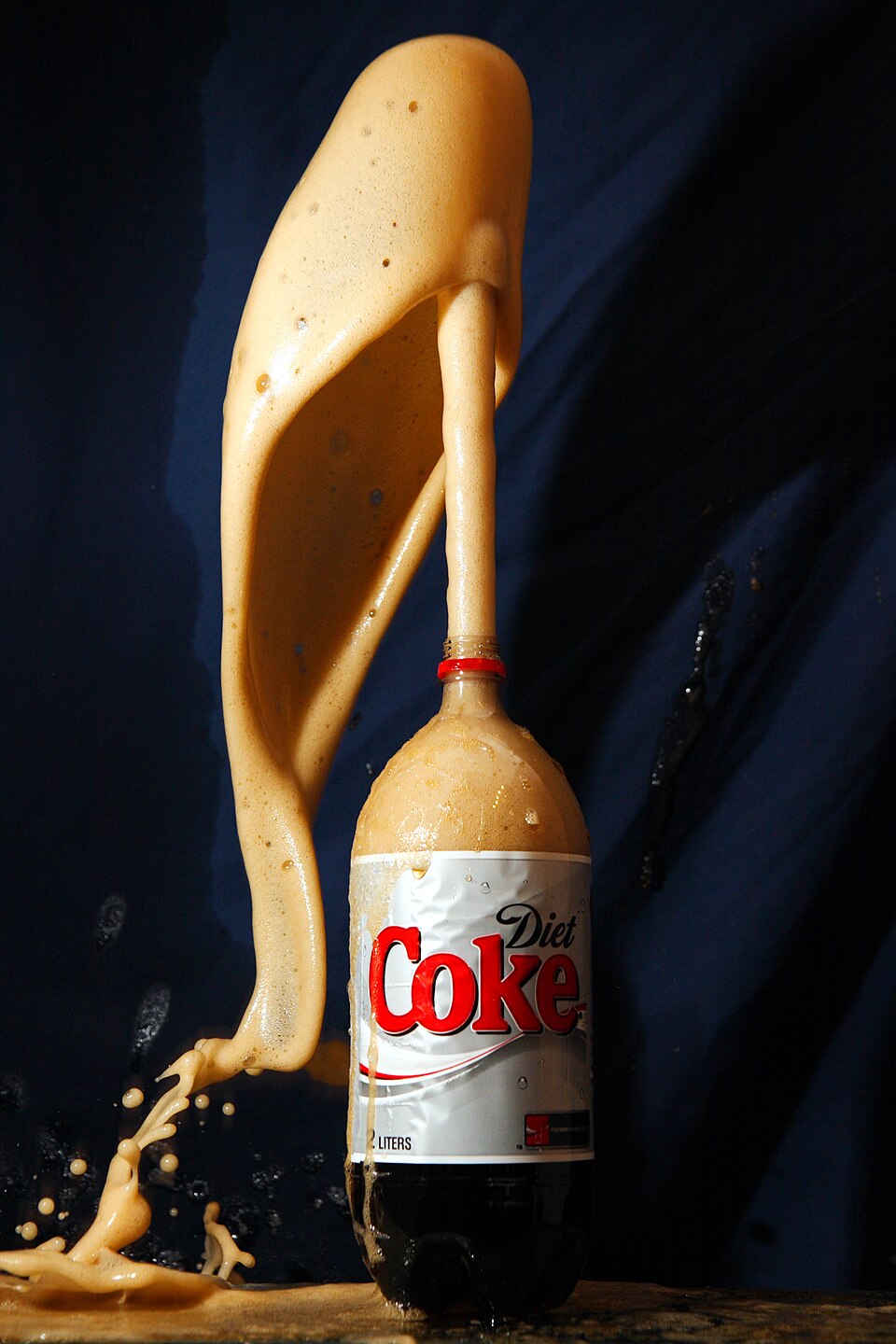
Mentos react with soda because their rough surface lets dissolved carbon dioxide escape fast, creating a geyser.
The reaction
Mentos are covered with tiny pits. They let carbon dioxide escape from soda quickly (nucleation sites).
Other factors
- Mentos sink fast.
- Gum arabic and gelatin reduce surface tension.
- Diet soda reacts more because of aspartame.
Not chemical
It is a physical reaction.
Safe
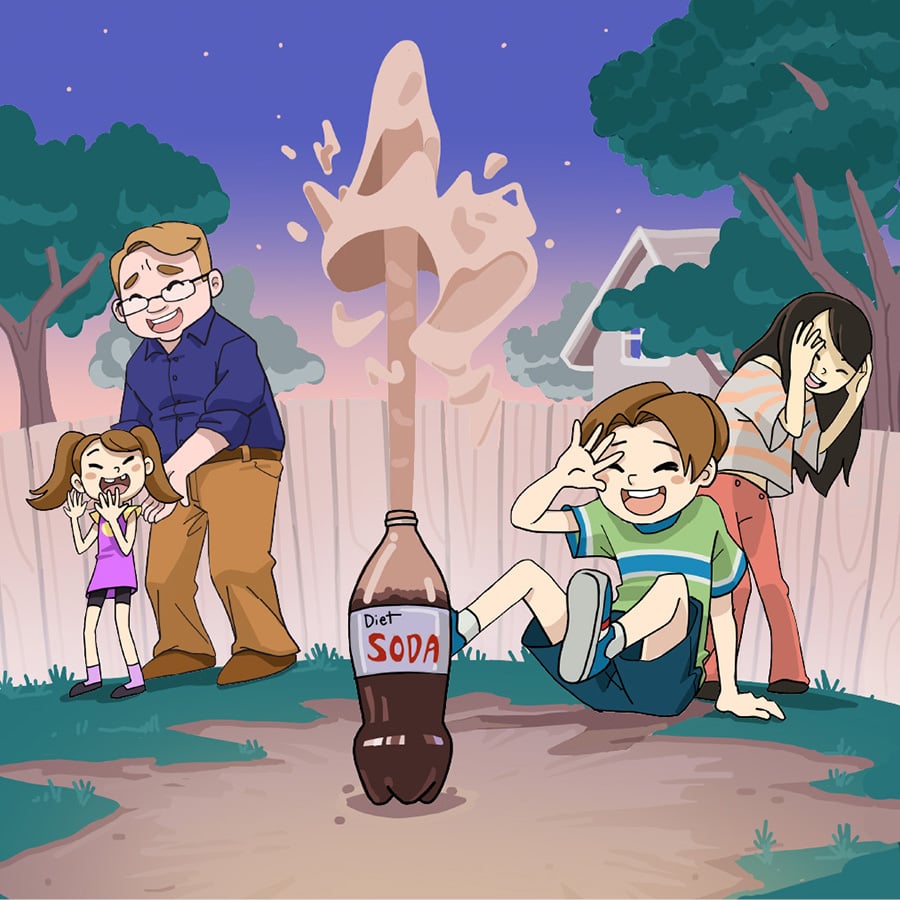
Do it outside.
Source
Popularized by Steve Spangler. A 2008 American Journal of Physics paper explained the physics.
The Mentos mechanism in numbers
The reaction is physical, not chemical. A Mentos candy has a rough surface with many tiny pits that provide nucleation sites for dissolved carbon dioxide to form bubbles rapidly. Soda is supersaturated with CO2 under pressure, and dropping a candy in the bottle breaks surface tension and releases gas quickly. Diet soda is usually more reactive than regular because artificial sweeteners such as aspartame lower surface tension more than sugar.
- Research published in the American Journal of Physics in 2008 by Tonya Coffey of Appalachian State University found that the candy’s rough surface and density, rather than ingredients alone, drive the reaction.
- Warm soda produces a larger eruption because gas is less soluble at higher temperatures.
- Dropping many candies at once through a tube produces a taller geyser.
Safety
Eruptions can reach several meters. Wear eye protection, do it outdoors and keep a distance. Eating many Mentos then drinking soda is not dangerous in a chemical sense, but the foaming gas can cause discomfort. The famous demonstrations, such as EepyBird’s 2006 videos, used about 100 liters of diet soda and hundreds of candies for fountain effects.
Chemistry of the geyser
When Mentos candy is dropped in diet soda, it creates carbon dioxide bubbles rapidly. The rough surface of the candy creates nucleation sites where dissolved CO2 forms bubbles quickly, and the candy sinks, so bubbles form throughout the bottle and push liquid out. Physicist Tonya Coffey of Appalachian State University studied the effect and published in the American Journal of Physics in 2008, reporting that surface roughness is a key factor and that aspartame and potassium benzoate in diet soda lower surface tension.
Safety
Do the experiment outdoors and keep faces away from the bottle. Diet soda works better than regular soda because of its lower sugar and surface tension. It is not poisonous, and the stomach rupturing myth is false, though swallowing a lot of carbonated drink and candy quickly can cause discomfort.
The reaction in numbers
A 2 liter bottle of diet soda and about 7 Mentos mints can produce a geyser over 6 meters (20 feet) high. Mentos have a rough surface under a microscope, with many pits that act as nucleation sites. Gum arabic and gelatin in the candy reduce surface tension and help bubbles form. The candy is dense, so it falls to the bottom of the bottle quickly, creating bubbles through the full depth of the liquid.

Safe experiment guidelines
Use protective glasses, do it outdoors on grass, and drop the candy using a card tube or a funnel. Do not drink the soda afterwards. The experiment was popularized by Fritz Grobe and Stephen Voltz in 2006 with a video of Mentos and diet soda fountains.
Based on data from the American Journal of Physics and Appalachian State University