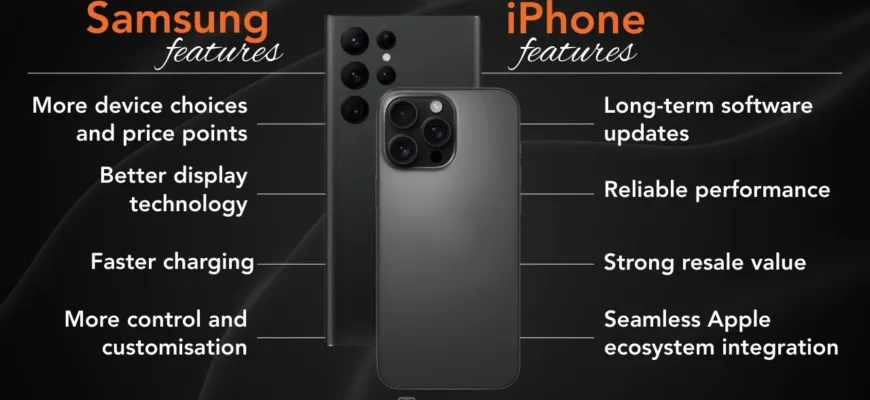
Neither is better in general. iPhone offers tight integration with Apple devices, while Samsung offers more customization and hardware variety, so it depends on your needs.
iPhone
- iOS with long software support (6 to 7 years).
- Tight integration with Mac, iPad and Apple Watch.
- High resale value.
- Fewer hardware choices.
Samsung Galaxy
- Android with more customization.
- Wider choice of prices, from $200 to $1,800.
- Strong screens, zoom cameras and S Pen on Ultra models.
- 7 years of updates on newer flagships.
Which
Choose by ecosystem, budget and features.
Selection criteria

A better pick depends on needs. Apple iPhones use iOS, receive major updates for about 5 to 7 years, and have the highest resale value among phones. Samsung Galaxy phones use Android with One UI. Samsung’s flagship Galaxy S series gets 7 years of OS updates and security patches from the Galaxy S24 onward.
- Camera: both offer strong cameras. Samsung offers wider zoom hardware on Ultra models, while iPhone leads in video recording stability.
- Charging: Samsung commonly offers faster wired charging, up to 45W on Ultra models, versus about 20 to 30W on iPhones.
- Ecosystem: iPhone works best with Mac, iPad, AirPods and Apple Watch, while Galaxy works best with Galaxy Watch, Buds and Windows integration.
- Customization: Android allows more home screen changes and default app choices.
Price and storage
US starting prices for flagship phones are close, around 800 to 1,300 USD for base to Ultra and Pro Max models. Samsung phones tend to discount faster after launch. iPhones keep resale value longer. Storage cannot be expanded on either brand in recent flagships, so choose 256 GB if you record much video. Security-focused buyers get regular patches on both platforms.

Selection criteria
iPhone and Samsung Galaxy flagships are close in performance. iPhones use Apple’s iOS, which gets around 5 to 7 years of updates, and have strong resale value. Samsung Galaxy phones use Android with One UI and offer 7 years of updates on recent models, plus features such as S Pen on Ultra models and more customization. iPhone models start around 799 USD and Galaxy S models around 799 to 899 USD.
Practical points
Choose iPhone if you use a Mac, Apple Watch or iMessage. Choose Samsung if you prefer open file systems, expandable options on some models, or wider choice of price. Both support 5G, high quality cameras and fast charging. Check trade in offers and carrier deals.
Updates and ecosystems
Apple promises iOS updates for about 5 to 7 years after release, while Samsung offers 7 years of updates for the Galaxy S24 and later. Apple iMessage, AirDrop and Handoff work well among Apple devices, and Samsung has Galaxy Buds, Watch and Quick Share. Both brands lead global smartphone shipments, with Apple at about 18 to 20 percent and Samsung at about 19 to 20 percent according to IDC and Counterpoint.

Price and trade in
Base iPhones start near 799 USD and base Galaxy S models near 799 USD, with storage upgrades costing 100 to 200 USD per tier. iPhones retain more resale value on average after 2 years. Samsung often discounts heavily within months of release. Evaluate camera, screen refresh rate (120 Hz on Pro and Ultra models), battery life and repairability.
Based on data from IDC, Counterpoint Research and manufacturer websites