A mutual fund pools investors’ money into a mix of assets, often actively managed, while an index fund passively tracks a market index and usually has lower fees.
Mutual fund
Pools money into stocks and bonds. Can be actively managed with higher fees (expense ratio often 0.5% to 1%+).
Index fund
A type of mutual fund (or ETF) that tracks an index like the S&P 500. Fees are lower, often 0.03% to 0.2%.
Performance
Over 15 years, about 88% of large cap active funds trailed the S&P 500 (SPIVA 2023).
Choosing
Index funds suit long term investors. This is not personal advice.
Management style
An actively managed mutual fund has a manager who selects stocks to try to beat the market. An index fund passively tracks a market index, such as the S&P 500, by holding the same stocks.
Costs
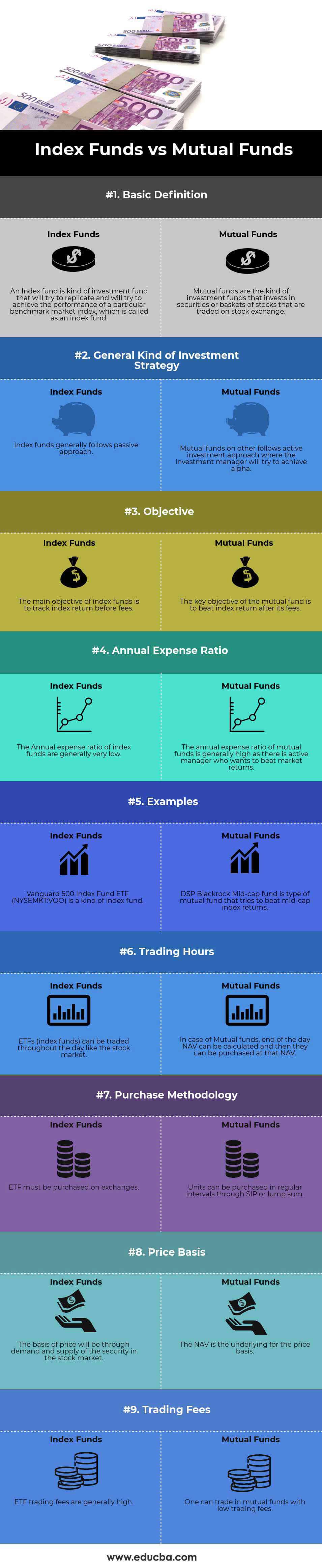
Actively managed funds have higher expense ratios, averaging about 0.6% to 0.7% for equity funds, compared with around 0.05% to 0.15% for many index funds, according to the Investment Company Institute and Morningstar. Over 30 years, 0.5% extra in fees can reduce the final balance by about 10% to 15%.
Performance
The SPIVA scorecard from S&P Dow Jones Indices shows that over 15 years, about 88% of large cap US equity funds underperformed the S&P 500. Some active funds beat the market in some years, but few do so consistently.
Taxes
Index funds trade less, so they generate fewer taxable capital gains distributions in taxable accounts.
Types
Index mutual funds and index ETFs (exchange traded funds) are similar. ETFs trade throughout the day like stocks, and mutual funds are priced once per day.
Minimums
Some mutual funds have minimum investments of 1,000 to 3,000 dollars. Many ETFs and fractional share programs have no minimum.
History
John Bogle at Vanguard launched the first retail index fund in 1976.
Diversification
An S&P 500 index fund holds about 500 large US companies. Total market and international index funds provide broader coverage.
Choosing
Compare expense ratios, tracking error, tax efficiency, your goals and time horizon. This is not investment advice. A licensed financial advisor can provide personalized guidance.
Risk
All stock funds can lose value. Past performance does not guarantee future results.
Fees and returns in detail
Index funds track a benchmark like the S&P 500 and generally charge very low expense ratios, often 0.03 to 0.20 percent, while actively managed mutual funds average around 0.5 to 0.7 percent. SPIVA reports from S&P Dow Jones Indices have found that over 15 years roughly 85 to 90 percent of active US large cap funds underperformed the S&P 500. Over decades, a 1 percent fee difference can reduce final value significantly.

Tax efficiency and access
Index funds and ETFs tend to distribute fewer capital gains because of low turnover. Actively managed funds may suit specialized segments such as small markets or bonds where manager skill can matter more. Many index funds have no minimums or low ones, such as Fidelity zero fee funds. Check expense ratio, tracking error and tax situation. Past performance does not guarantee future results.
Based on data from S&P Dow Jones Indices SPIVA reports and Morningstar