Planets orbit the Sun because the Sun’s gravity pulls on them while their sideways motion keeps them from falling in.
Why
The Sun holds 99.86% of the solar system’s mass. Its gravity pulls the planets. Planets also move sideways, so they keep falling around the Sun instead of into it. This is an orbit.
Law
Newton’s law of gravitation and Kepler’s laws describe orbit shapes (ellipses).
Speeds
Earth orbits at about 67,000 mph (30 km/s).
Year
One Earth orbit takes 365.25 days.
Origin
Planets formed from a spinning disk of gas and dust.
Gravity and inertia
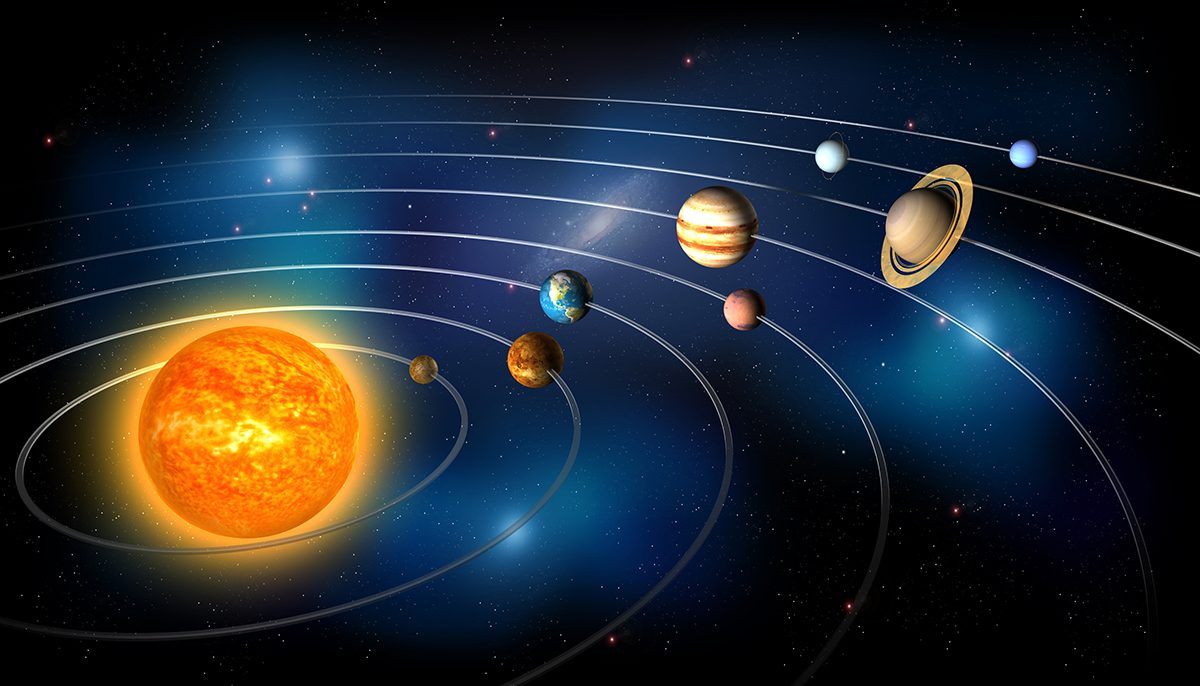
The Sun contains 99.86% of the mass in the solar system, and its gravity pulls on planets. Planets also have forward motion (inertia) from the cloud of gas and dust that formed the solar system 4.6 billion years ago. The balance between inward gravity and sideways motion produces an orbit instead of falling in or flying away.
Newton and Kepler
Isaac Newton described gravity in 1687 in Principia, showing that the force depends on the masses and distance. Johannes Kepler had earlier described the laws of planetary motion (1609 to 1619):
- Orbits are ellipses with the Sun at one focus.
- A planet sweeps equal areas in equal times, so it moves faster when closer to the Sun.
- The square of the orbital period is proportional to the cube of the average distance.
Orbital speeds
Mercury travels at about 47 kilometers per second (170,000 km/h), Earth at about 30 kilometers per second (107,000 km/h) and Neptune at about 5.4 kilometers per second.
Years of the planets
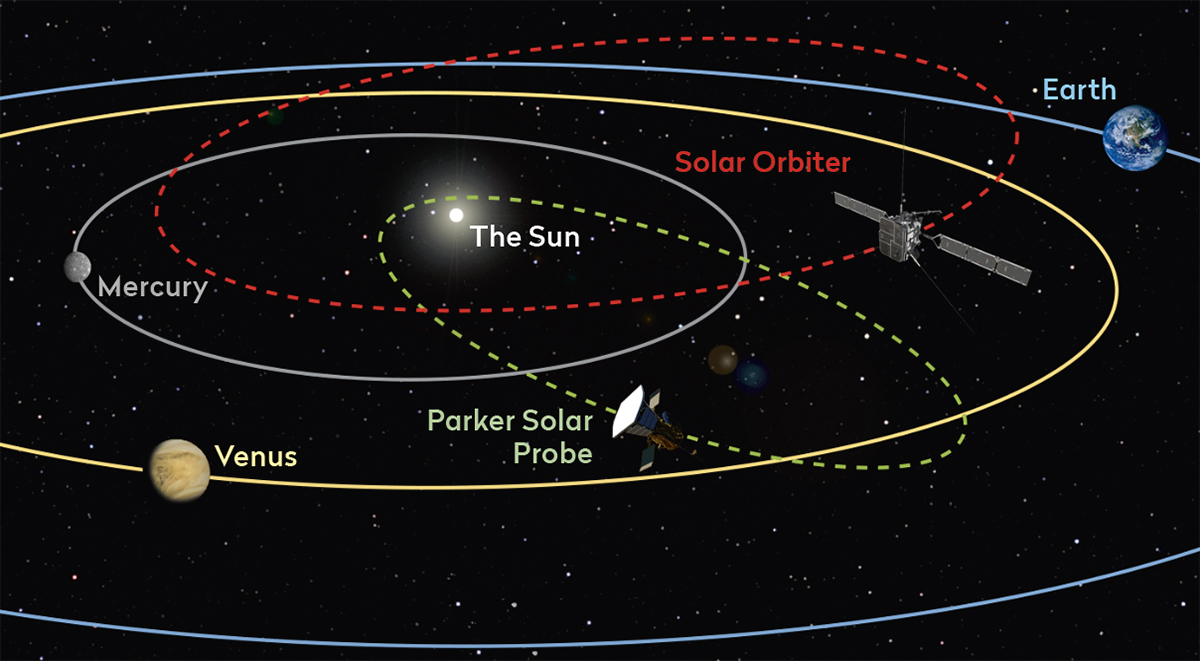
Mercury has an 88 Earth day year, Venus 225 days, Earth 365.25 days, Mars 687 days, Jupiter 11.9 years, Saturn 29.5 years, Uranus 84 years and Neptune 165 years.
Orbit shape
Planetary orbits are slightly elliptical. Earth’s distance varies from 147.1 million kilometers (perihelion, early January) to 152.1 million kilometers (aphelion, early July).
Flat solar system
Planets orbit in nearly the same plane and the same direction because the solar system formed from a spinning disk of gas and dust.
Einstein
General relativity (1915) describes gravity as the curvature of spacetime, explaining small deviations such as Mercury’s orbit precession.
Moving Sun
The Sun itself orbits the center of the Milky Way at about 230 kilometers per second, once every 225 to 250 million years.
Physics behind orbits
Planets orbit because the Sun’s gravity pulls them while their sideways speed keeps them from falling in. Johannes Kepler’s laws describe orbits as ellipses with the Sun at one focus, with planets moving faster when closer. Newton’s law of universal gravitation, published in 1687, explained why. Earth orbits at an average distance of 149.6 million km (1 astronomical unit) at about 29.8 km/s.

The solar system’s structure
The planets orbit nearly in the same plane and direction because the solar system formed from a rotating disk of gas and dust about 4.6 billion years ago. Mercury completes an orbit in 88 days, Venus in 225, Mars in 687, Jupiter in about 11.9 years and Neptune in about 165 years. Einstein’s general relativity describes gravity as curved spacetime, which explains Mercury’s orbital precession.
Based on data from NASA and the International Astronomical Union