A function is differentiable at a point if its derivative exists there, which means it is smooth with no corner, cusp, or break.
Definition
A function f is differentiable at x = a if the derivative limit exists: lim (h to 0) of (f(a+h) minus f(a)) / h.
Meaning
The graph has a well defined tangent line, and is smooth with no sharp corners.
Not differentiable
- Corners (|x| at 0).
- Cusps.
- Vertical tangents.
- Discontinuities.
Link
Differentiable implies continuous, but not the reverse.

Example
f(x) = x squared is differentiable everywhere.
Formal definition
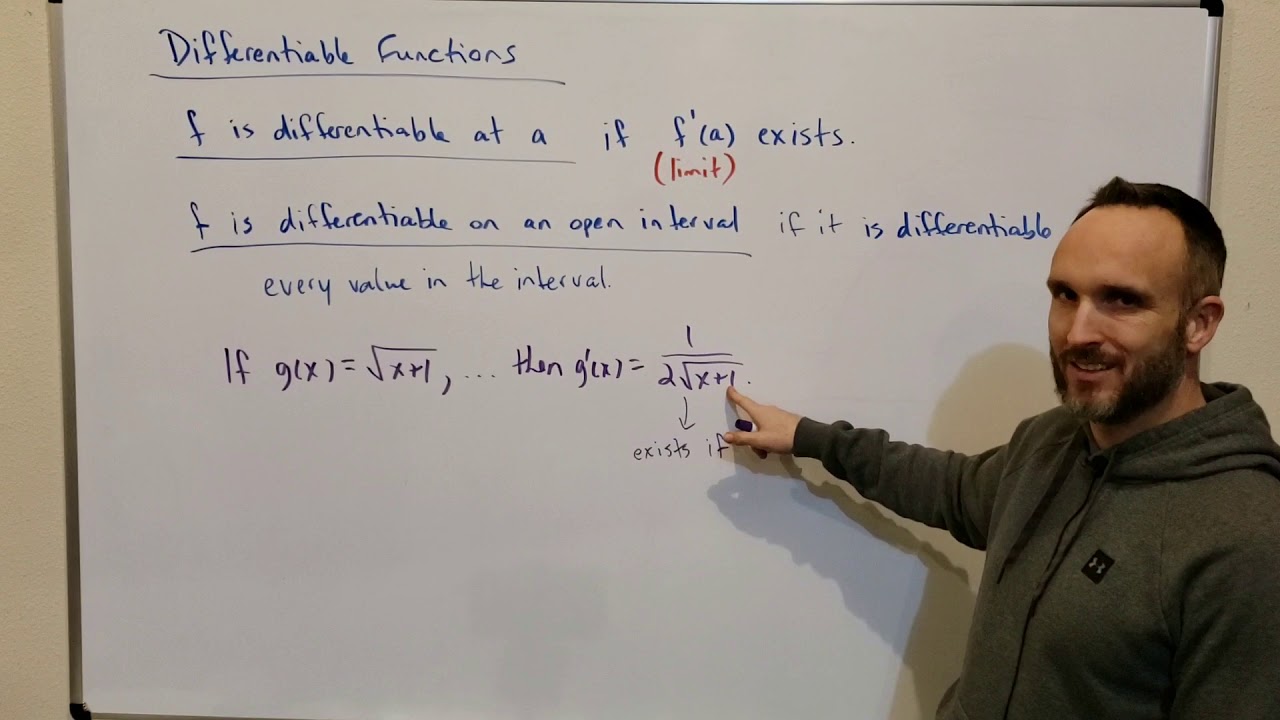
A function f is differentiable at a point x = a if the limit of (f(a + h) – f(a)) / h as h approaches 0 exists and is finite. That limit is the derivative f'(a), the slope of the tangent line. A function is differentiable on an interval if it is differentiable at every point there.
- Differentiability implies continuity, but continuity does not imply differentiability.
- The function f(x) = |x| is continuous at 0 but not differentiable there because the left slope is -1 and the right slope is +1, giving a corner.
- Cusps, vertical tangents and discontinuities are other points where a derivative does not exist.
- Karl Weierstrass published in 1872 a function that is continuous everywhere but differentiable nowhere.

Example
For f(x) = x squared, the derivative is 2x, defined everywhere. For f(x) = cube root of x, the function is continuous but has a vertical tangent at 0, so it is not differentiable there. In multiple variables, differentiability requires a good linear approximation, and existence of partial derivatives alone is not enough.
Formal definition
A function f is differentiable at a if the limit of (f(a+h) minus f(a)) divided by h exists as h approaches 0. That limit is the derivative f'(a). Differentiable functions are continuous, but continuous functions are not always differentiable.
Example
f(x)=|x| is continuous at 0 but not differentiable there, because the left slope is minus 1 and the right slope is plus 1. The Weierstrass function is continuous everywhere and differentiable nowhere.
Theorems about differentiability
If a function is differentiable at a point, it is continuous there. Differentiable functions satisfy the mean value theorem, and the chain rule, product rule and quotient rule hold. A function is not differentiable at corners, cusps, vertical tangents or discontinuities. For multivariable functions, differentiability needs the existence of a linear approximation, not just partial derivatives.
Examples and uses
f(x)=x^2 is differentiable everywhere with f'(x)=2x. f(x)=|x| fails at 0. The cube root function has a vertical tangent at 0. Derivatives define instantaneous rate of change, used for velocity, marginal cost and optimization. Isaac Newton and Gottfried Leibniz developed calculus in the 17th century.
Based on data from MIT OpenCourseWare and Khan Academy