A producer makes its own food, such as plants, and a consumer gets energy by eating other organisms.
Producer
An organism that makes its own food. Plants and algae use photosynthesis. Also called autotrophs.
Consumer
An organism that eats other organisms for energy (heterotrophs). Types: herbivores, carnivores, omnivores.
Decomposers
Fungi and bacteria break down dead matter.
Food chain

Energy flows from producers to consumers. Only about 10% of energy passes to the next level.
Roles in numbers
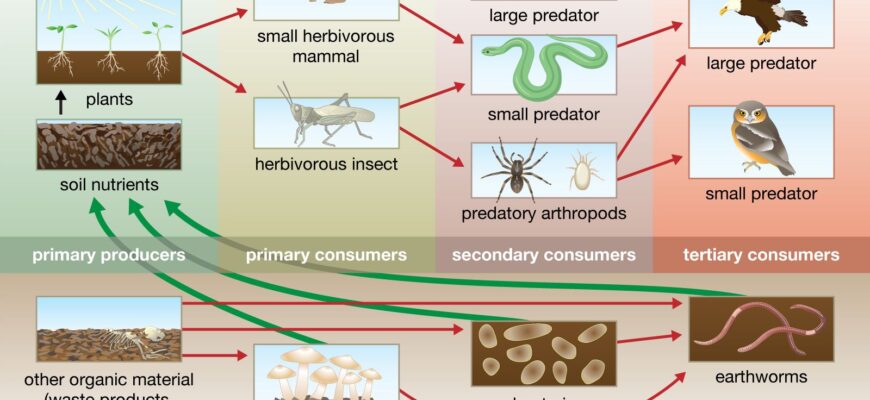
Producers (autotrophs) make their own food, mostly using photosynthesis, and include plants, algae and cyanobacteria. Consumers (heterotrophs) get energy by eating others. Primary consumers eat producers, secondary consumers eat primary consumers, and tertiary consumers eat secondary ones. Decomposers such as fungi and bacteria break down dead matter.
- About 10 percent of energy passes from one trophic level to the next, called the 10 percent rule, so food chains rarely exceed 4 or 5 levels.
- Oceanic phytoplankton produce roughly half of Earth’s oxygen.
- Chemosynthetic bacteria at hydrothermal vents are producers that use chemical energy rather than light.
Examples

A grass, rabbit, fox chain shows a producer, a primary consumer and a secondary consumer. Omnivores like bears feed at several levels. Detritivores such as earthworms and dung beetles eat dead organic material. Removing a key species can change a whole ecosystem, as in the reintroduction of wolves to Yellowstone in 1995, which affected elk behavior and vegetation.
Roles in an ecosystem
Producers (autotrophs) make their own food from sunlight, as in photosynthesis, or from chemicals, and form the base of food chains. Consumers (heterotrophs) get energy by eating other organisms. Primary consumers eat producers, secondary consumers eat primary consumers, and decomposers break down dead matter. Typically only about 10 percent of energy passes from one trophic level to the next.
Examples
Plants, algae and cyanobacteria are producers. Rabbits are primary consumers, foxes are secondary consumers, and fungi and bacteria are decomposers. In an economic sense, producers make goods and services and consumers use them.
Ecological pyramids
Photosynthesis converts roughly 1 to 2 percent of incident sunlight into biomass in most plants. Earth’s producers fix about 100 billion tons of carbon annually, with half in the ocean by phytoplankton. Energy transfer efficiency between trophic levels is about 10 percent, so food chains seldom exceed four or five levels.

Types of consumers
Herbivores eat plants, carnivores eat animals and omnivores eat both. Decomposers and detritivores recycle nutrients. Chemoautotrophs at hydrothermal vents are producers without sunlight. In economics, producers supply goods and consumers demand them, which sets prices.
Based on data from the National Geographic Society and the Smithsonian