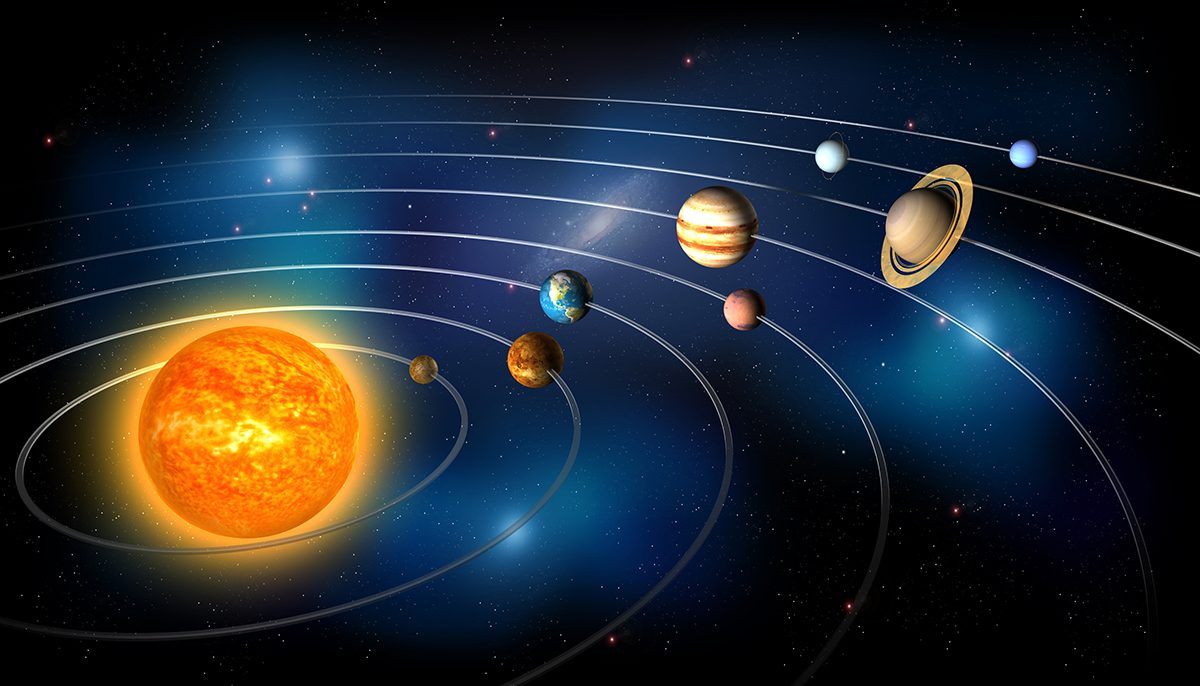
Planets orbit the Sun because the Sun’s gravity pulls on them while their sideways motion keeps them from falling in.
Why
The Sun’s gravity pulls on planets. Planets also move sideways. The mix of the two creates an orbit.
Mass
The Sun holds 99.86% of the solar system’s mass.
Shape
Orbits are ellipses (Kepler’s first law).
Speed
Mercury orbits at about 107,000 mph. Earth at 67,000 mph.
Origin
Planets formed from the spinning disk of gas and dust around the young Sun, about 4.6 billion years ago.
Kepler’s laws in numbers
Johannes Kepler published his three laws between 1609 and 1619. The first law says planets move in ellipses with the Sun at one focus. The second says a line from the Sun to a planet sweeps equal areas in equal times, so planets move faster when closer to the Sun. The third says the square of the orbital period is proportional to the cube of the average distance from the Sun.
- Mercury orbits at about 47.4 km/s and completes a year in 88 days.
- Earth orbits at about 29.8 km/s and takes 365.25 days.
- Neptune orbits at about 5.4 km/s and takes about 164.8 Earth years.
- Earth’s orbit is nearly circular, with an eccentricity of about 0.017. Mercury’s is about 0.206.

Why orbits do not decay
Planets keep moving because nothing in space creates meaningful drag at their distance. Gravity bends their path continuously, so each planet is in a state of free fall around the Sun while moving sideways fast enough to keep missing it. The Sun holds about 99.86 percent of the Solar System’s mass, which is why it sits near the center. Newton’s law of gravitation, published in 1687, explains Kepler’s laws, and Einstein’s general relativity adds a small correction that accounts for Mercury’s orbit shifting by about 43 arcseconds per century.
Orbital periods and distances
Planets follow Kepler’s third law: the square of the orbital period in years equals the cube of the average distance from the Sun in astronomical units. Mercury sits at 0.39 AU and takes 88 days, Venus at 0.72 AU takes 225 days, Earth at 1 AU takes 365.25 days, Mars at 1.52 AU takes 687 days, Jupiter at 5.2 AU takes 11.86 years, Saturn at 9.58 AU takes 29.5 years, Uranus at 19.2 AU takes 84 years and Neptune at 30.1 AU takes about 165 years. Orbital speed falls with distance: Mercury moves at about 47 km/s, Earth at 29.8 km/s and Neptune at roughly 5.4 km/s.
Why orbits last
There is almost no friction in space, so a planet keeps its momentum for billions of years. Gravity continuously bends its path, the balance between forward motion and the pull of the Sun producing a stable ellipse. Tidal and relativistic effects cause tiny changes: Mercury’s orbit precesses by 574 arcseconds per century, of which general relativity explains about 43. Computer models show the inner solar system is chaotic over hundreds of millions of years, but a collision within the next few billion years is unlikely.
Mass, gravity and energy of orbits
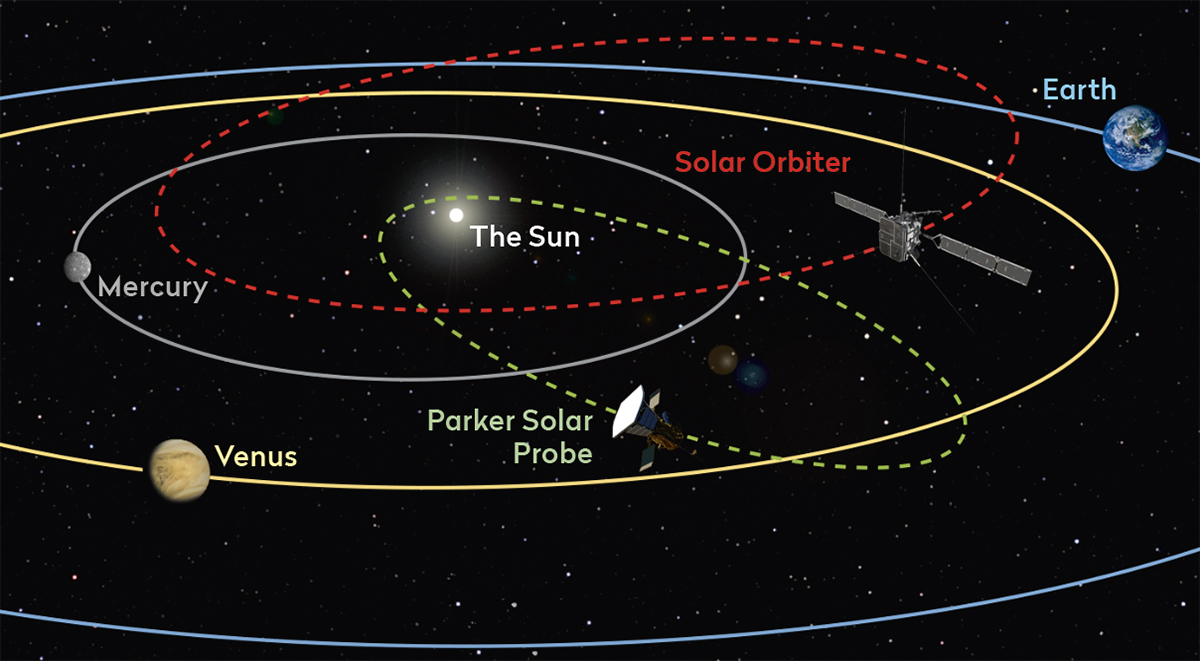
The Sun contains about 99.86 percent of the mass of the solar system, roughly 1.989 x 10^30 kg, so its gravity dominates every planetary path. Earth’s orbital speed of about 29.8 km/s and distance of 149.6 million km balance the Sun’s pull exactly enough to keep an almost circular orbit with an eccentricity of 0.017. Mercury’s orbit is the most eccentric of the planets at 0.206. A planet in a circular orbit needs a speed of v = sqrt(GM/r), which is why outer planets move more slowly.
How the orbits were measured
Tycho Brahe’s precise naked eye observations of Mars were analyzed by Kepler and published in 1609 and 1619. Newton showed in 1687 that an inverse square force produces elliptical orbits. Neptune was predicted from irregularities in Uranus’s orbit and found in 1846, a famous confirmation of Newtonian gravity.
Based on data from NASA’s Jet Propulsion Laboratory and the International Astronomical Union